Categories
Materials & Systems

How Long Do Tile Roofs Really Last?

Tile roofs are often marketed as “lifetime” systems—but what does that really mean? After extensive research into manufacturer data, building codes, and independent studies, we found that tile roofs can last anywhere from 40 to over 100 years, depending on the material, installation, and maintenance.

In this guide, we’ll break down what affects a tile roof’s lifespan, how different materials compare, and what to expect for your home over time.

Understanding Tile Roof Longevity

Tile roofing isn’t a single material. It includes clay, concrete, slate, metal, composite, and even solar tiles, each with unique strengths and service lives. While the tile itself can last for decades, the underlayment beneath it usually fails first—often between 25 and 40 years.

Our research included findings from the Tile Roofing Industry Alliance, IBHS, and ASTM material standards (C1167 for clay, C1492 for concrete). Each source confirms that environmental stress—especially heat, moisture, and wind—has a greater impact on lifespan than tile type alone.

If you’re comparing roof types, you can also review our breakdown of architectural shingle lifespans to understand how tile systems outperform asphalt in long-term durability.

Average Lifespan by Tile Type

Tile MaterialTypical Lifespan (Years)Notes
Clay Tile50–100Fired natural material, highly durable. Often outlasts its underlayment.
Concrete Tile40–75Heavy and water-absorbent; underlayment wear often limits total lifespan.
Slate Tile75–150+Natural stone; requires structural support and skilled installation.
Composite Tile30–50Lightweight synthetic blend; mimics natural tile but with shorter life.
Metal Tile Panels40–70Formed steel or aluminum with tile appearance; corrosion protection required.
Solar Roof Tiles25–30Limited by photovoltaic efficiency degradation, not structure.

Each figure assumes proper installation, balanced ventilation, and periodic underlayment replacement. Without maintenance, these ranges drop sharply.

The Real Limiting Factor: Underlayment

Many homeowners hear that a clay or slate roof “lasts a century.” That’s true for the tile itself—but not the underlayment.

Underlayment membranes protect your roof deck from moisture. According to the National Roofing Contractors Association (NRCA), their lifespan is much shorter than the tiles they support:

  • Asphalt felt: 20–30 years
  • Synthetic underlayment: 30–40 years
  • Self-adhering bitumen: up to 40+ years

Once the underlayment deteriorates, water intrusion becomes inevitable, regardless of how intact the tiles look.

Regional Climate Impact

Tile longevity is also influenced by weather patterns. Research from the Insurance Institute for Business & Home Safety found that aging, UV exposure, and wind uplift all reduce service life faster than age alone.

Climate RegionRealistic LifespanPrimary Stressors
Hot–Dry (Southwest)40–70 yearsUV degradation, underlayment drying, thermal expansion.
Coastal / Hurricane Zones35–60 yearsSalt corrosion, wind uplift, flying debris.
Freeze–Thaw Regions30–60 yearsMoisture infiltration, cracking, and spalling.
Temperate / Mild Zones70–100 yearsMinimal stress; ideal performance.

These differences explain why tile roofs in Arizona age differently than those in Northern California or the Northeast.

Tile Roof Lifespan by Region

While average lifespans depend on material and maintenance, local climate plays a major role. Here are just a few states and how they can be different.

Arizona:
Tile roofs in Arizona typically last 40–70 years because of intense heat and UV exposure that dry out the underlayment. Regular inspections and attic ventilation are critical.
Find roofers in Arizona

Florida:
High humidity, salt air, and hurricane-grade winds reduce life expectancy to about 35–60 years. Clay and concrete tiles perform best with hurricane-rated fastening systems.
Find roofers in Florida

California:
Tile roofs in coastal and inland California often reach 60–100 years, especially in dry southern regions where freeze-thaw stress is minimal. Underlayment usually needs replacement around year 30.
Find roofers in California

Las Vegas (Nevada):
Dry desert heat and high UV exposure shorten underlayment life; expect 40–65 years total. Choose lighter-colored or ventilated tile systems to reduce heat load.
Find roofers in Las Vegas

Proper Installation Makes or Breaks Longevity

Tile systems are only as durable as their workmanship. Improper fastening, insufficient ventilation, or missing flashing can cut the roof’s life in half. The Tile Roofing Industry Alliance installation manual highlights key best practices:

  • Use correct fastening and mortar or foam adhesives rated for local wind zones.
  • Ensure ridge vents and intake ventilation meet IRC Section R806.
  • Install corrosion-resistant flashings and properly sealed valleys.
  • Limit roof access to professionals to prevent cracked tiles.

Maintenance That Extends Roof Life

Routine care plays a major role in how long your tile roof lasts. The Asphalt Roofing Manufacturers Association (ARMA) and TRIA recommend:

  • Annual inspections for broken or displaced tiles.
  • Gutter and debris cleaning to prevent trapped moisture.
  • Gentle washing (no high-pressure cleaning).
  • Replacement of damaged underlayment every few decades.
  • Prompt repairs after storms or heavy wind.

Homeowners who maintain these simple practices consistently achieve lifespans at the upper end of each range.

Why Some Tile Roofs Fail Early

In our research, early failures were almost always traced back to one of three causes:

  1. Poor underlayment choice — low-grade felt dries out or tears within 15–20 years.
  2. Improper flashing — valleys, chimneys, and wall junctions left vulnerable.
  3. Unbalanced ventilation — overheating accelerates material fatigue and adhesive breakdown.

Avoiding these pitfalls ensures the investment in tile roofing pays off over decades, not just years.

Comparing Tile Roofs to Other Roofing Materials

If you’re weighing your options, tile systems outperform most alternatives in longevity. Even high-end shingles or metal panels can’t match clay or slate in service life.
You can read more in our guides on how long 30-year architectural shingles really last and 8 types of shingles and their pros and cons.

For homeowners considering professional installation or inspection, you can find roofers in your area through our directory.

Bottom Line

After reviewing data from IBHS, TRIA, NRCA, and ASTM standards, here’s what we found:

Most clay or concrete tile roofs last 40 to 75 years in U.S. conditions.
Slate can exceed 100 years, while composite and solar tiles generally perform for 25 to 50.
The real determining factor is underlayment integrity—typically 25 to 40 years between replacements.

When installed correctly, ventilated properly, and maintained regularly, a tile roof can be a once-in-a-lifetime investment that protects your home for generations.
Categories
Materials & Systems

How Long Do 30-Year Architectural Shingles Really Last?

Most homeowners are told that architectural shingles should last thirty years. After extensive research into manufacturer data, independent testing, and national field studies, we’ve found that number is rarely accurate. The term “30-year shingle” refers to a warranty class, not a guaranteed lifespan. In practice, these roofs perform anywhere from the low-20s to about thirty years—and the difference almost always comes down to installation quality, climate stress, and attic ventilation.

What We Found When Comparing Research

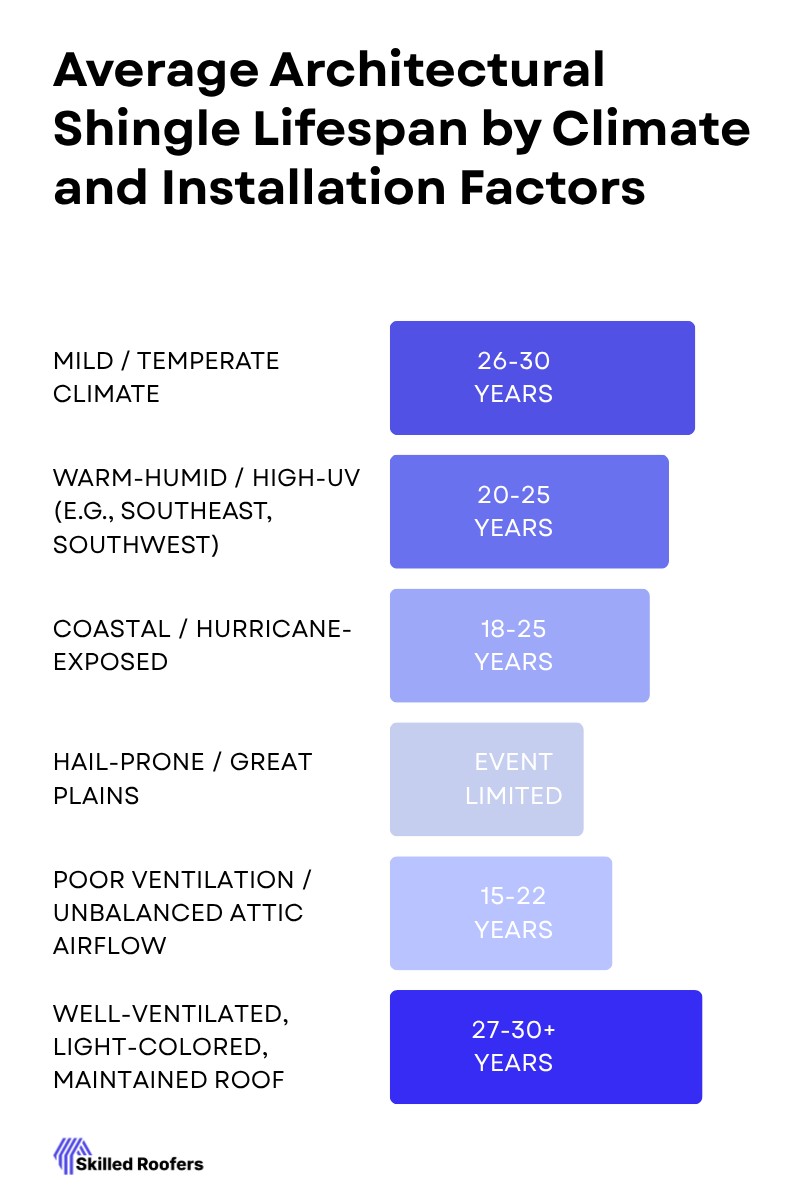
When we began comparing published lifespan data, one thing became clear: roofs built with identical shingles age very differently depending on region. In coastal and southern climates, the same brand labeled for 30 years often needs replacement around year 20 or 22. In more temperate zones—the Midwest or Northeast—many reach 27 to 30 years before significant aging appears.

Our findings align with the Institute for Business & Home Safety (IBHS) study, Performance of Asphalt Shingle Roofs in the Real World, which examined roof performance during Hurricanes Gustav and Ike. Their field data confirms that prolonged exposure to UV, wind, and temperature swings steadily weakens adhesion strength. The shingles don’t suddenly fail—they gradually lose resistance to wind and impact.

The InterNACHI life-expectancy chart supports this trend, placing architectural asphalt shingles at roughly 30 years under standard conditions. The key phrase is standard conditions. In regions with poor attic ventilation or extreme heat, real-world lifespans drop closer to 15–20 years.

Embed the infographic

Copy and paste this HTML:

Why “30 Years” Rarely Means 30 Years

Roofing ratings come from controlled lab tests—steady temperature, perfect sealing, and uniform wind exposure. Real roofs live through daily expansion, contraction, and moisture cycles that no laboratory replicates. Once shingles pass the 10-year mark, sealant bonds begin to weaken, and research from IBHS and Applied Research Associates shows a clear decline in wind resistance from that point onward.

Post-storm inspections summarized in those studies reveal that after a 60-mph wind event, newer Class H shingles retain strong adhesion, while older ones lift or lose corners even without visible cracking. That drop in holding strength isn’t cosmetic—it’s mechanical aging.

Ventilation also plays a defining role. Attic temperatures in poorly ventilated spaces can exceed 150°F, accelerating oil loss in the asphalt layer and making shingles brittle. Studies based on International Residential Code (IRC) Section R806 ventilation ratios (1:150 to 1:300) show significantly lower heat stress and longer roof service life when air movement is balanced between intake and exhaust.

The Role of Climate

Climate remains the single most decisive factor. In moderate regions with steady temperatures, architectural shingles often reach the upper 20s or full 30-year mark. In high-UV, hurricane, or hail-prone areas, lifespans consistently fall to the lower-20s.

Recent IBHS Florida field modeling now includes “aging factors” in its storm-loss data, validating what the National Severe Storms Laboratory (NOAA/NSSL) has long defined—winds above 50–60 mph are “damaging,” and roofs older than a decade show measurable increases in uplift and creasing at those speeds.

Extending Shingle Lifespan

Our review of building-science and manufacturer data highlights several practices that reliably extend roof life. Proper ventilation and balanced airflow are critical. Roof decks sealed according to IBHS’s FORTIFIED Roof™ guidelines experience far less water intrusion during storms—IBHS testing shows sealed decks can reduce interior water entry by up to 95%. Cooler roof surfaces—either from lighter shingle colors or reflective coatings—run 20–30°F cooler in peak heat, reducing thermal fatigue. The U.S. Department of Energy’s Energy Saver guide on cool roofs confirms that cooler roof surfaces retain flexibility longer and lose fewer granules over time.

The Asphalt Roofing Manufacturers Association (ARMA) provides further data showing that routine cleaning and avoiding pressure washing also helps maintain granule integrity and prolong shingle life.

The Realistic Expectation

So, how long do architectural shingles really last? After reviewing the available data, the most realistic range is 22 to 30 years. With correct installation, proper ventilation, and consistent maintenance, a roof can approach the high-20s. Without them, performance drops into the teens. When we encounter a 25-year-old roof still functioning well in case studies or manufacturer field reports, it’s the result of balanced conditions—not luck.

When Replacement Becomes the Smarter Choice

Age alone shouldn’t determine replacement, but it should trigger inspection. Research shows that early signs—granule loss, curling, or surface cracking—signal reduced protection even if leaks haven’t appeared yet. Roofs near the 20-year mark in storm-exposed regions should be inspected annually. Waiting until leaks form often means hidden deck damage has already begun, and replacement costs rise sharply.

Bottom line

After reviewing decades of field data from IBHS, InterNACHI, ARMA, the Department of Energy, and NOAA, we’ve concluded that the “30-year” rating describes ideal conditions rarely achieved in reality. With informed installation, ventilation, and maintenance, architectural shingles can reach the high-20s, but expecting the full thirty years without degradation is optimistic. The best approach is proactive care, realistic budgeting, and understanding what those numbers truly represent.

Categories
Materials & Systems

8 Types of Shingles (Pros and Cons)

Most people look at shingles as something that decorates the top of the home. It adds to the aesthetic appeal. However, the type of shingles that the builder chooses is highly dependent on what works best for the type of weather. 

The shingles also denote quality in a home. In the following article, we will be exploring eight different types of shingles. We will look at the pros and cons as well so that one can make an informed decision in the event of home building or re-roofing an existing abode.

1. 3 Tab Asphalt Shingles

This is probably the most common shingle that you will see around the block. It is a default for new homes and re-roofing projects alike. The total cost of putting a roof on with these should be from $5000 to $8000. 

Pros

  • Standard in the Industry
  • Simple installation process
  • Affordable
  • Usually in Stock at Stores

Cons

  • Don’t withstand a lot of wear and tear
  • Not very thick

2. Metal Roof

There are many different types of metal roofs, such as corrugated, sheet, and shingle. Additionally, there are disparate materials such as aluminum, copper, and steel. A metal roof can withstand all types of weather.

Pros

  • Long-lasting
  • Not heavy
  • Has interesting aesthetics due to the many different types available

Cons

  • They are prone to getting leaks in them as they can tear on a roof
  • The color and shine wear off
  • They can be easily dented 

3. Clay Tiles

When it comes to clay, you often see them in homes in hot climates. This is because they are ideal for this type of weather as they help to keep the cool air in. They are often in lighter colors too, as this helps to keep the house cooler as the light reflects off of them. They give a Spanish or Mediterranean feel to a place.

Pros

  • Gives the home an upscale appeal and increases the property value
  • Can last for a long time (upwards of 80 years)
  • Great for hot weather due to the insulation that they provide
  • Environmentally friendly

Cons

  • Difficult to install
  • Initially, they are a costly investment
  • Quite heavy
  • They don’t work in cold climates generally
  • If there are cracks or breakage, this will lead to a leaky roof

4. Wood Shingles

Some people really like the wood cabin appeal that can be created with wood shingles. It also has a Germanic style to it. However, not all cities or townships allow wood shingles. They can easily catch fire, so it can be a hazard. For this reason, it is often against the building codes in many areas to get them.

Pros

  • It gives a rustic look and feel.
  • It lasts a relatively long time with an average lifespan of 50 years.
  • Good for the environment
  • Insulation improves energy efficiency

Cons 

  • There is a possibility that they might increase the price of insurance as they are a fire hazard.
  • Hard to install
  • Repairs are not easy to make

5. Architectural Shingles

These have an extra layer of laminate on them, so they will last a long time. The average lifespan for architectural shingles is 30 to 50 years. They give the home a refined look. The price point for installation is a little higher, but this is considered an upgrade from the 3 Tab. 

In fact, the extra price is worth it because the roof will last twice as long. Those who like wood shingles but are not allowed to have them can get these. They have a similar aesthetic to wood.

Pros

  • Relatively long life span
  • They have an extra layer of protection as well
  • They have a luxurious look to them
  • There are types available for people to do their projects and then there are ones that generally require professional installation

Cons

They are expensive at $1.50 to $5.50 per square foot

6. Slate Shingles

Slate shingles are actually shingles that are made out of stone. There are natural slate tiles but there are also synthetics available as well. They generally work well in residential houses. They give a unique appeal in terms of looks. The lifespan is generally around 40 years.

Pros

  • Good for all types of weather, such as snow, rain, and sun
  • Works well for small homes or even in condos
  • They are good for the environment
  • They help a home to get a better resale value
  • The lifespan is reasonable

Cons

  • They are heavy as they are made of stone
  • The installation and raw materials are both very costly
  • They generally don’t have a lot of choice for colors other than grey
  • Repairs are complicated and generally not DIY
  • It can be hard to find the same kind when it’s time for a replacement

7. Rubber Roofing

There are two types of rubber roofing, natural and synthetic. Rubber roofing is made from materials such as bitumen, BUR, TPO, and PVC. It is commonly used in both commercial and residential buildings.For example, an industrial complex can have rubber roofing or a laboratory. Also though, it can just as easily be used in a single-family home. 

Pros

  • It is a light material
  • It will last an average life of about 40 years
  • Environmentally friendly
  • One does not need to put in a lot of maintenance 

Cons

  • Color does not stay on long
  • They can be flimsy
  • These are not DIY projects and need professionals to install them properly
  • Needs a professional for maintenance work 

8. Solar Shingles

These environmentally friendly shingles will help you to get the most bang for your buck over the long term. However, in the short term, the installation costs can be expensive. As there continue to be innovations in the industry, the price will drop as it has started to. They are even better for the environment than a roof with standard shingles and solar panels mounted to it.

Pros

  • Over time, the investment begins to pay off with energy savings
  • It has a nice aesthetic akin to slate
  • One of the best roofing options for the environment

Cons

  • It costs a lot upfront to install
  • Need professional help to install
  • It is still only clear for very sunny climates like those closer to the equator or in the South of the US

Conclusion

There is a lot to love about the options that shingles provide. A person just needs to do a little research to realize everything that shingles have to offer. Unfortunately, some of the best kinds, such as solar, can only be used in warm climates. 

However, there are many types still available for every climate, such as metal or rubber. A person should review the cons and pros before deciding on a shingle type.

Some of the types, such as metal, can come with regret if a person doesn’t want to hear the rain on the roof. All in all, there is enough on the market for a person to make a definite and informed choice.